Artificial Intelligence Trends Shaping Technology in 2026
By News Story US • February 28, 2026
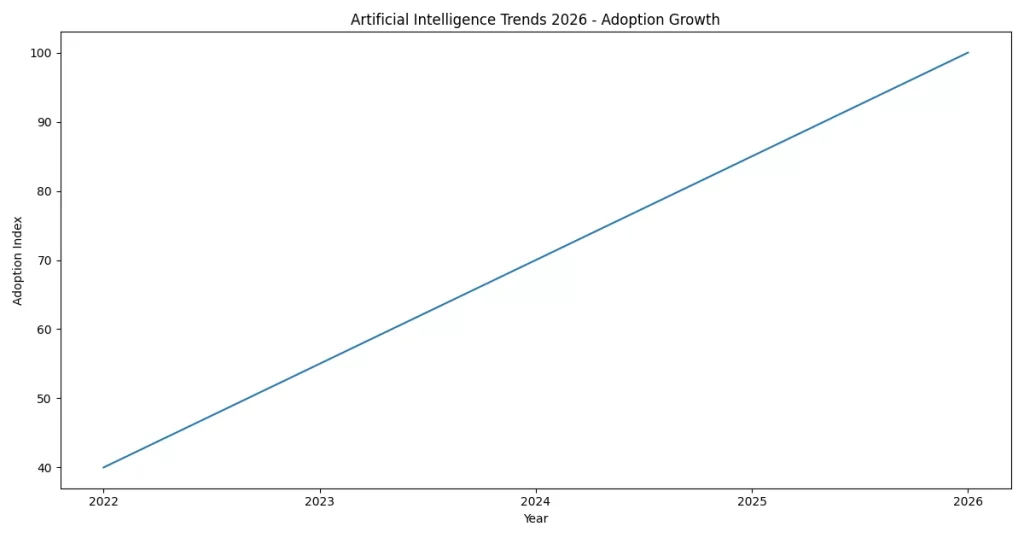
The artificial intelligence trends 2026 reflect continued innovation across industries, including healthcare, finance, education, and manufacturing. AI technologies are evolving beyond experimentation and increasingly becoming integrated into daily operations, digital services, and enterprise systems.
In 2026, artificial intelligence development focuses on responsible deployment, improved efficiency, and practical applications rather than speculative hype. Businesses and policymakers are paying closer attention to transparency, governance, and long-term sustainability.
Why Artificial Intelligence Trends 2026 Matter
The artificial intelligence trends 2026 matter because AI systems are influencing how organizations operate and how consumers interact with digital platforms.
Key drivers behind AI growth include:
- Increased computing power
- Expansion of cloud infrastructure
- Improved machine learning algorithms
- Greater availability of structured data
AI tools are being deployed to automate workflows, enhance customer support, improve cybersecurity, and analyze complex datasets.
Enterprise Adoption of AI
One of the most significant artificial intelligence trends 2026 is widespread enterprise adoption. Businesses are using AI-powered systems for:
- Predictive analytics
- Customer behavior analysis
- Fraud detection
- Supply chain optimization
- Process automation
According to technology research published by the National Institute of Standards and Technology (NIST):
https://www.nist.gov/
Responsible AI frameworks are becoming central to enterprise adoption strategies.
AI in Healthcare and Research
Healthcare remains a major focus area for AI integration.
Artificial intelligence systems are being used to:
- Analyze medical imaging
- Assist in diagnostics
- Support drug research
- Improve hospital workflow efficiency
AI tools are designed to assist professionals rather than replace clinical judgment. Regulatory bodies continue to monitor AI implementation to ensure safety and transparency.
Information on digital health innovation can be accessed through the U.S. Department of Health & Human Services:
https://www.hhs.gov/
Ethical AI and Governance
Ethical considerations are a core component of artificial intelligence trends 2026.
Key governance areas include:
- Data privacy protection
- Bias mitigation
- Transparency in algorithm design
- Accountability in automated decision systems
Governments and international organizations are working on frameworks to ensure AI systems operate responsibly.
The Organisation for Economic Co-operation and Development (OECD) provides AI policy guidance:
https://www.oecd.org/ai/
AI and Workforce Transformation
Artificial intelligence technologies are influencing workforce structures. Rather than eliminating jobs entirely, AI systems often shift the nature of tasks.
Examples include:
- Automating repetitive data entry
- Enhancing customer service support
- Supporting data-driven decision making
Workforce training and digital skills development remain important for adapting to technological change.
Cybersecurity and AI
AI systems are increasingly used to detect and prevent cybersecurity threats.
Machine learning models can:
- Identify unusual activity patterns
- Flag potential fraud
- Monitor network traffic
However, AI can also be used maliciously, which is why cybersecurity oversight remains critical.
The Cybersecurity and Infrastructure Security Agency (CISA) provides security guidance:
https://www.cisa.gov/
Stock Market Reaction to Economic Data in 2026
AI in Consumer Technology
Artificial intelligence continues to shape consumer technology platforms.
Examples include:
- Voice assistants
- Recommendation engines
- Smart home systems
- Image and speech recognition tools
These technologies are designed to improve user experience while maintaining privacy safeguards.
Cloud Computing and AI Infrastructure
Cloud infrastructure plays a key role in enabling artificial intelligence trends 2026. Scalable computing resources allow organizations to deploy machine learning systems without building in-house infrastructure.
Cloud-based AI platforms support:
- Real-time data processing
- Application development
- Enterprise analytics
The integration of AI with cloud computing continues to drive digital transformation.
Regulatory Landscape in 2026
Regulation is becoming an important theme within artificial intelligence trends 2026.
Governments are focusing on:
- Consumer data protection
- Transparency requirements
- Risk-based AI classification
- Cross-border cooperation
Balanced regulation aims to encourage innovation while protecting users.
Long-Term Outlook for AI Development
The long-term trajectory of AI development depends on:
- Research investment
- Talent availability
- International collaboration
- Ethical standards
Artificial intelligence technologies are likely to continue evolving gradually rather than through sudden breakthroughs.
Connection to Broader Economic Trends
Technology innovation, including AI development, influences broader economic activity. AI adoption may support productivity improvements and operational efficiency across industries.
Economic indicators such as employment and inflation can indirectly influence technology investment trends, as discussed in our analysis of the US jobs report 2026 and the US inflation CPI report 2026.
(Internal links to your previous articles)
FAQs
1. What are the key artificial intelligence trends 2026?
Key trends include enterprise adoption, ethical governance, healthcare applications, and AI-driven cybersecurity systems.
2. Is AI replacing human jobs?
AI often automates repetitive tasks but also creates demand for new technical skills and oversight roles.
3. How is AI regulated?
Governments and international organizations are developing frameworks to ensure transparency and accountability.
4. Where can I find official AI policy resources?
Official resources are available from NIST and OECD.
5. Is AI safe to use in business operations?
When implemented responsibly and with oversight, AI can improve efficiency and decision-making.
Conclusion
Artificial intelligence trends 2026 reflect a shift from experimental development toward practical, responsible deployment across industries. As governance frameworks mature and enterprise adoption expands, AI systems are increasingly becoming integrated into everyday digital infrastructure.
Continued research, transparency, and collaboration will shape the future of artificial intelligence development in the years ahead.