How AI Is Changing Jobs: 10 Key Shifts in 2026
By News Story US • April 1, 2026
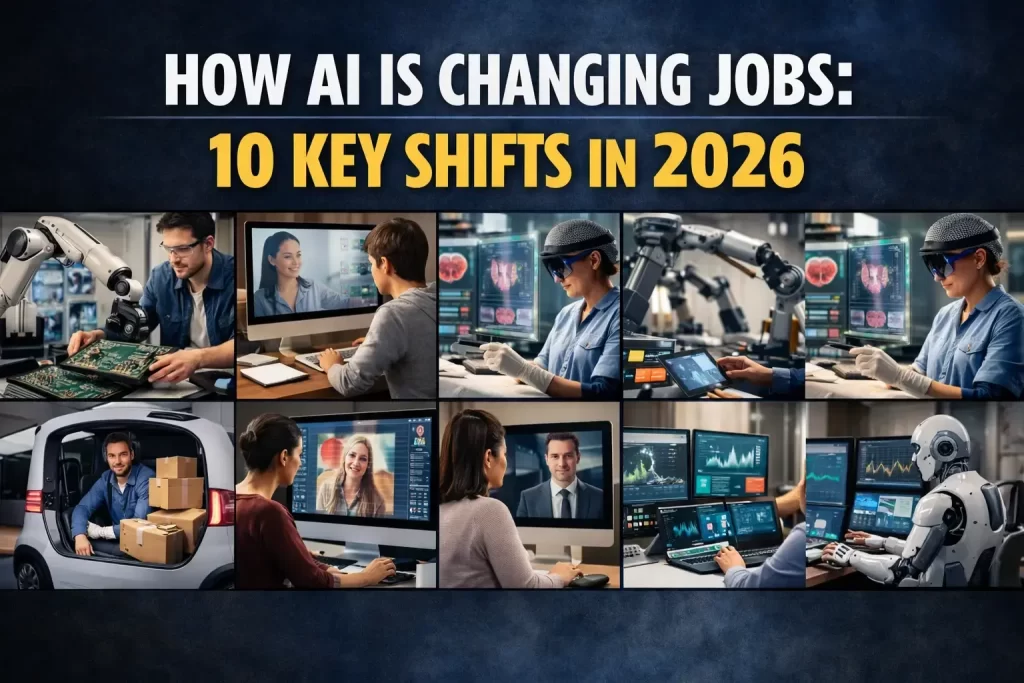
In 2026, artificial intelligence isn’t just a buzzword—it’s reshaping the global economy at lightning speed. From automating mundane tasks to augmenting human creativity, how AI is changing jobs has become the defining question for workers, employers, and policymakers alike. As we hit March 2026, reports from McKinsey and the World Economic Forum highlight that AI could automate up to 45% of work activities by 2030, but it’s already accelerating job evolution today.
This article dives deep into the seismic shifts: which jobs are vanishing, which are booming, and the skills you need to thrive. Whether you’re a professional eyeing your next move or a business leader building teams, understanding how AI is changing jobs equips you to navigate this transformation.
The Rise of AI: A Quick Snapshot of 2026 Trends
AI adoption exploded in 2025, fueled by affordable tools like advanced large language models (LLMs) and multimodal AI systems. By early 2026, 78% of companies report using AI daily, per Gartner data. This isn’t hype—it’s happening now.
Key drivers include:
- Generative AI proliferation: Tools like Grok 4.1 and successors handle coding, writing, and design.
- Edge AI: Smarter devices process data locally, boosting efficiency in manufacturing and healthcare.
- Regulatory push: EU AI Act and U.S. guidelines ensure ethical deployment, creating compliance jobs.
These forces amplify how AI is changing jobs, blending opportunity with disruption. Let’s break it down.
Job Displacement: Roles AI Is Automating Away
No discussion of how AI is changing jobs is complete without addressing displacement. AI excels at repetitive, data-heavy tasks, hitting entry-level and mid-skill roles hardest.
Routine White-Collar Jobs Vanish
Data entry clerks, basic accountants, and customer service reps face the biggest threats. AI chatbots now resolve 70% of queries without humans, per Forrester. In 2026, tools like AI-powered ERP systems (e.g., SAP’s Joule) automate payroll and invoicing.
- Call centers: Reduced by 40% as voice AI mimics human empathy.
- Legal support: Contract review bots scan documents 10x faster than paralegals.
- Manufacturing assembly: Robotic arms with AI vision assemble products with 99.9% accuracy.
A 2026 Oxford study estimates 300 million full-time jobs globally at risk, but it’s not all doom—displacement creates a ripple of new opportunities.
Blue-Collar Shifts in Physical Labor
Even hands-on jobs aren’t immune. Autonomous drones deliver packages in Delhi and beyond, slashing logistics roles. Warehouse robots from Amazon and Ocado pick items flawlessly.
| Job Category | AI Impact in 2026 | % Jobs at Risk |
|---|---|---|
| Data Entry | Fully automated | 95% |
| Truck Driving | Partial (long-haul) | 60% |
| Retail Cashiers | Self-checkout AI | 75% |
Transitioning workers need reskilling—more on that later.
Job Creation: New Roles Emerging from AI
Here’s the flip side: how AI is changing jobs means invention, not just destruction. For every role automated, 1.5-2 new ones emerge, says the WEF’s 2026 Future of Jobs report.
High-Demand AI Specialist Positions
- AI Ethicists: Ensure bias-free systems; salaries average $180K in the U.S., ₹25L in India.
- Prompt Engineers: Craft inputs for LLMs; a role nonexistent in 2023, now with 500K global openings.
- AI Trainers: Fine-tune models with human feedback, blending tech and domain expertise.
Augmented Roles Across Industries
AI doesn’t replace humans—it supercharges them. Radiologists using AI diagnostics spot cancers 30% faster. Marketers leverage predictive analytics for hyper-personalized campaigns.
In creative fields:
- Graphic designers now “co-pilot” with AI tools like Midjourney 2026, focusing on strategy.
- Writers use AI for drafts, humans for narrative depth.
India’s IT sector exemplifies this: NASSCOM predicts 1 million AI-related jobs by 2026 end, from Bengaluru to Delhi.
Sector-Specific Transformations: How AI Is Changing Jobs by Industry
How AI is changing jobs varies by sector. Here’s a 2026 breakdown.
Healthcare: From Diagnosis to Personalized Care
AI analyzes MRIs in seconds, freeing doctors for patient interaction. Nurse shortages? AI monitors vitals via wearables.
New skills: Telemedicine AI integration, genomic data analysis.
Finance: Trading Bots and Fraud Fighters
Algorithmic trading handles 85% of stock volume. Robo-advisors manage portfolios for millennials.
Booming: Cybersecurity AI specialists defending against deepfake fraud.
Education: Personalized Learning Revolution
AI tutors adapt to student pace, reducing teacher admin by 50%. Platforms like Duolingo’s AI evolve into full curricula.
Teachers shift to mentors, emphasizing emotional intelligence.
Manufacturing and Logistics: Smart Factories
Predictive maintenance AI cuts downtime 40%. In Delhi’s auto hubs, AI optimizes supply chains amid global disruptions.
The Skills Revolution: What Workforce Needs in 2026
How AI is changing jobs demands a skills overhaul. Routine cognitive skills depreciate; human-AI collaboration rises.
Top Skills AI Can’t Replicate (Yet)
- Creativity and Innovation: AI generates ideas; humans connect dots uniquely.
- Emotional Intelligence: Empathy in sales, therapy—irreplaceable.
- Complex Problem-Solving: Ethical dilemmas in AI governance.
- Adaptability: Lifelong learning mindset.
- Digital Literacy: Using AI tools ethically.
Per LinkedIn’s 2026 report:
- AI/ML proficiency up 75% in job postings.
- Soft skills like resilience now in 60% of descriptions.
According to reports from World Economic Forum and McKinsey & Company , AI could automate up to 45% of work activities by 2030.
Upskilling Pathways for 2026
Governments and companies invest billions. India’s Skill India 2.0 targets 400 million workers with AI modules.
- Free Platforms: Coursera (Google AI Essentials), Khan Academy AI tracks.
- Corporate Programs: Google’s Grow with Google, Microsoft’s AI Skills Initiative.
- Bootcamps: 12-week programs yielding $120K jobs.
Example: A Delhi call center worker reskills in prompt engineering via UpGrad, landing a remote role at ₹15L/year.
Challenges and Ethical Concerns in AI Workforce Shifts
How AI is changing jobs brings hurdles.
Inequality and the Skills Gap
Low-skill workers in developing regions like rural India face exclusion. Women, often in admin roles, bear 55% of displacement risk (ILO 2026).
Solutions: Universal basic income pilots in Finland expand; subsidies for reskilling.
Bias and Job Access
AI hiring tools perpetuate biases if trained on skewed data. Regulations mandate audits.
Mental Health Toll
“AI anxiety” spikes; 40% of workers fear obsolescence, per Deloitte.
Real-World Examples: AI Job Stories from 2026
Consider Sarah, a U.S. paralegal. AI took her doc-review job, but she upskilled in legal AI ethics, now consulting for firms.
In India, Raj from Mumbai’s logistics firm trained on AI route optimization, boosting his team’s efficiency 25% and earning a promotion.
These stories show how AI is changing jobs favors the adaptable.
Future-Proofing Your Career: Actionable Steps
To thrive as AI evolves:
- Assess Your Role: Use tools like FutureFit AI to gauge automation risk.
- Learn AI Basics: Start with free Python/ML courses on edX.
- Build Hybrid Skills: Combine domain expertise with AI (e.g., nursing + data analytics).
- Network: Join AI communities like Delhi AI Meetup.
- Stay Agile: Dedicate 5 hours/week to learning.
By 2030, 85% of jobs will be new, per WEF. Start now.
Policy and Global Responses to AI Job Changes
Governments act:
- U.S.: AI Talent Act funds 100K training slots.
- EU: Right to Upskill mandates employer programs.
- India: ₹10,000 crore AI Mission trains 1 crore youth.
International pacts like G20 AI Accord promote equitable transitions.
Related Articles
- 7 Ways Artificial Intelligence Is Transforming Global Industries
- Inside the Global Race to Build Responsible AI Systems
- Artificial Intelligence Trends Shaping Technology in 2026
Conclusion: Embrace the AI Job Wave
How AI is changing jobs in 2026 is a double-edged sword—disrupting old paths while forging innovative ones. The workforce of tomorrow belongs to those who blend human strengths with AI prowess. Don’t fear the change; master it.