7 Ways Artificial Intelligence Is Transforming Global Industries
By News Story US • March 3, 2026
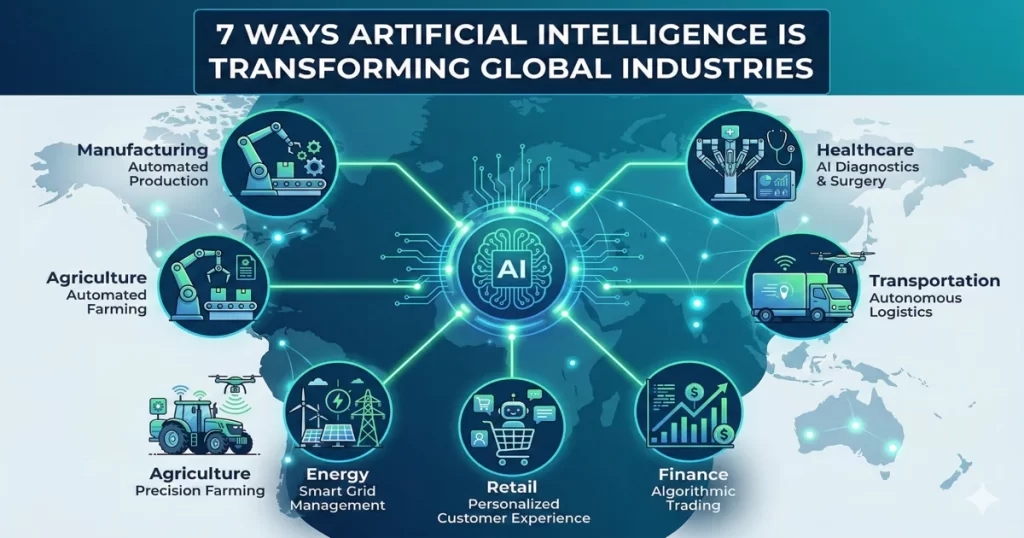
Understanding 7 ways artificial intelligence is transforming global industries has become essential in 2026 as AI technologies expand across healthcare, finance, manufacturing, retail, cybersecurity, education, and economic infrastructure.
Artificial intelligence is no longer experimental. It now supports enterprise decision-making, optimizes production systems, enhances digital security, and powers advanced analytics across global markets.
Below are seven key ways artificial intelligence is transforming industries worldwide.
1. Artificial Intelligence is transforming in Healthcare Systems
Healthcare remains one of the most impactful areas where artificial intelligence is transforming global industries.
AI-powered tools assist with:
- Medical imaging analysis
- Pattern recognition in diagnostics
- Workflow automation in hospitals
- Early-stage research modeling
These systems support medical professionals by analyzing large datasets quickly and efficiently. AI applications in healthcare operate under regulatory oversight to ensure safety and transparency.
The U.S. Department of Health & Human Services provides digital health resources:
https://www.hhs.gov/
AI enhances decision support rather than replacing clinical expertise.
2. AI-Driven Transformation in Financial Services
Financial institutions increasingly rely on artificial intelligence to improve security and efficiency.
AI supports:
- Fraud detection through anomaly monitoring
- Credit risk modeling
- Automated compliance analysis
- Customer service systems
As discussed in our article on the stock market reaction to economic data, AI tools now help analyze financial trends and market behavior.
Machine learning models process transaction data in real time, reducing operational risk while supporting customer experience.
3. Smart Manufacturing and Industrial Automation
Manufacturing operations illustrate clearly how artificial intelligence is transforming global industries.
AI enables:
- Predictive maintenance of machinery
- Automated quality control
- Robotics optimization
- Real-time production monitoring
By reducing downtime and improving efficiency, AI systems help modernize industrial production under Industry 4.0 initiatives.
Sensors and analytics tools continuously monitor equipment performance, improving operational reliability.
4. Retail, E-Commerce, and Consumer Analytics
Retail businesses leverage AI to enhance supply chain planning and customer engagement.
AI systems are used for:
- Inventory demand forecasting
- Personalized product recommendations
- Dynamic pricing analysis
- Customer behavior insights
Cloud infrastructure supports these systems, as explored in our coverage of cloud computing trends 2026.
(Internal link to Cloud Computing article)
Retail AI applications focus on efficiency and responsiveness rather than speculative automation.
5. Cybersecurity and Digital Threat Prevention
Cybersecurity represents another major example of how artificial intelligence is transforming global industries.
AI-driven security systems can:
- Detect abnormal network activity
- Identify phishing patterns
- Analyze security logs
- Automate incident response
As detailed in our cybersecurity trends 2026 article, AI enhances threat detection across enterprise networks.
The National Institute of Standards and Technology (NIST) publishes cybersecurity frameworks:
https://www.nist.gov/
AI strengthens digital resilience in a connected economy.
6. Education, Research, and Scientific Modeling
Education systems and research institutions increasingly integrate artificial intelligence into learning platforms and scientific analysis.
AI tools assist with:
- Personalized learning systems
- Academic performance analytics
- Climate modeling
- Biomedical research simulations
Universities and laboratories use AI to process large datasets that would otherwise require extensive manual analysis.
Responsible deployment remains central to maintaining transparency in educational environments.
7. Global Economic and Productivity Impact
Perhaps the broadest impact of artificial intelligence is its influence on global productivity.
As outlined in our global economic outlook 2026 article, technological innovation supports long-term economic growth.
AI contributes to:
- Data-driven business decision-making
- Process optimization
- Supply chain coordination
- Workforce efficiency
However, economic benefits depend on workforce training, regulatory clarity, and infrastructure investment.
Ethical Governance and Responsible AI Development
Understanding how artificial intelligence is transforming global industries also requires examining governance frameworks.
Key priorities include:
- Data privacy protection
- Bias mitigation
- Algorithm transparency
- Accountability mechanisms
International organizations such as the OECD provide AI governance principles:
https://www.oecd.org/ai/
Responsible innovation ensures that AI development aligns with public trust and global standards.
Long-Term Outlook for Artificial Intelligence
The transformation driven by AI is expected to continue gradually. Rather than abrupt disruption, AI integration typically occurs through incremental adoption across enterprise systems.
Future development will likely focus on:
- Improved model transparency
- Secure cloud integration
- Workforce training
- Cross-border research collaboration
Sustainable growth depends on balanced regulation and technological accountability.
FAQs
1. How artificial intelligence is transforming global industries?
AI enhances efficiency, supports analytics, and automates repetitive processes across healthcare, finance, manufacturing, retail, cybersecurity, and education.
2. Does AI replace human workers?
AI typically reshapes tasks and improves efficiency rather than eliminating entire industries.
3. Which industries benefit most from AI adoption?
Healthcare, financial services, manufacturing, retail, cybersecurity, and research sectors show significant AI integration.
4. Is artificial intelligence regulated?
Governments and international organizations are developing frameworks to guide responsible AI deployment.
5. Where can I find official AI governance resources?
Official guidelines are available through OECD and NIST websites.
Conclusion
These seven areas demonstrate clearly how artificial intelligence is transforming global industries in 2026. From healthcare systems to financial markets and global productivity networks, AI supports data-driven decision-making and operational efficiency.
Responsible governance, workforce development, and technological transparency remain essential for ensuring sustainable integration of artificial intelligence worldwide.